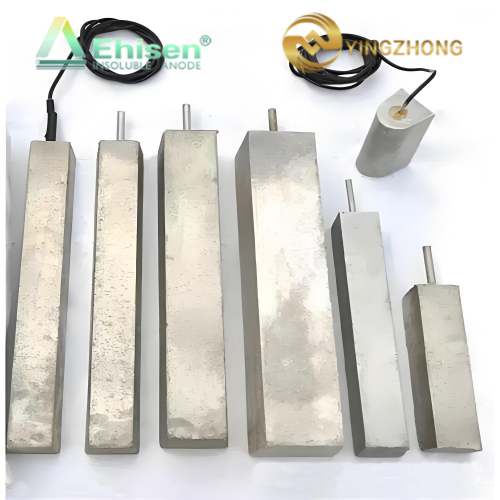
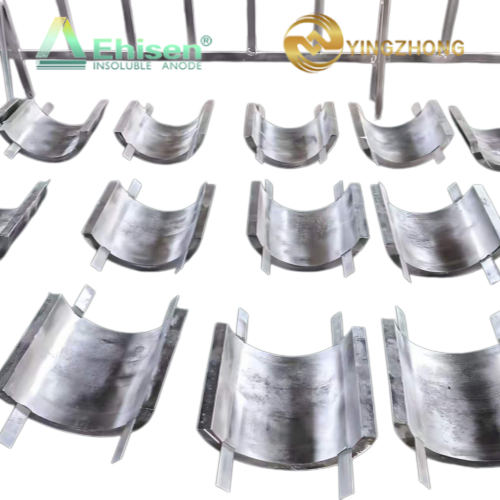
specifications
Model | Weight(Kg) | Dimensions [L×(upper W+lower W)×H](mm) |
MG-2 | 2+0.1 | 350×(72+52)×52 |
MG-4 | 4+0.2 | 350×(95+75)×75 |
MG-8 | 8+0.2 | 700×(95+75)×75 |
MG-11 | 11+0.2 | 700×(110+90)×88 |
MG-14 | 14+0.2 | 700×(120+100)×102 |
MG-22 | 22+0.2 | 700×(150+130)×125 |
chemical compositions
Model | Chemical compositions(%) | |||||||
| Alloy elements | Others (No more than) | ||||||
| Al | Zn | Mn | Mg | Fe | Cu | Ni | Si |
MGAZ63B | 5.3-6.7 | 2.5-3.5 | 0.15-0.6 | balance | 0.003 | 0.01 | 0.001 | 0.08 |
MGAZ31B | 2.5-3.5 | 0.60-1.4 | 0.2-1.0 | balance | 0.003 | 0.01 | 0.001 | 0.08 |
MGM1C | ≤ 0.01 |
| 0.5-1.3 | balance | 0.01 | 0.01 | 0.001 | 0.05 |
working environment and applications
working environment
The standard Magnesium anode has a nominal corrosion potential of -1.55 volts (relative to a Cu/CuSO4 reference electrode). It is well for soil conditions with resistivity under 20 Ω·cm.
Applications
pipeline under the ground
outside wall of the storage banks
other metal structure underground
D Magnesium anode
D Magnesium anode is also called high potential magnesium anode, which has a higher open circuit voltage. It produces an open circuit potential of negative 1.7~1.75 volts. This will produce output current and achieves a greater efficiency. They are ideally suited for structures buried in soils with resistivity exceeding 8,000 Ω·cm.